Convert inches to millimeters using the calculator above. Enter a measurement in inches to see the equivalent length in millimeters.
One inch is exactly equal to 25.4 millimeters.
How to Convert Inches to Millimeters
Multiply the measurement in inches by 25.4:
Millimeters = Inches × 25.4
Example: Convert 5 inches to millimeters
Multiply 5 by 25.4:
5 in × 25.4 = 127 mm
Therefore, 5 inches equals 127 millimeters.
Accuracy and Rounding
The converter calculates through each unit’s relationship to the meter. Some results terminate exactly, while others continue as non-terminating decimals and must be rounded for display.
Keep the full conversion factor during intermediate calculations. Round only the final answer to the precision justified by the original measurement.
Common Inches to Millimeters
| Inches (in) | Millimeters (mm) |
|---|---|
| 0.1 in | 2.54 mm |
| 0.5 in | 12.7 mm |
| 1 in | 25.4 mm |
| 2 in | 50.8 mm |
| 3 in | 76.2 mm |
| 5 in | 127 mm |
| 10 in | 254 mm |
| 12 in | 304.8 mm |
| 24 in | 609.6 mm |
| 36 in | 914.4 mm |
Fractional Inches to Millimeters
Inch measurements are often written as fractions, especially on rulers, tools, screws and building materials. Use this chart to find the metric equivalent of common fractions.
| Fractional inches | Decimal inches | Millimeters |
|---|---|---|
| 1/16 in | 0.0625 in | 1.5875 mm |
| 1/8 in | 0.125 in | 3.175 mm |
| 3/16 in | 0.1875 in | 4.7625 mm |
| 1/4 in | 0.25 in | 6.35 mm |
| 5/16 in | 0.3125 in | 7.9375 mm |
| 3/8 in | 0.375 in | 9.525 mm |
| 1/2 in | 0.5 in | 12.7 mm |
| 5/8 in | 0.625 in | 15.875 mm |
| 3/4 in | 0.75 in | 19.05 mm |
| 7/8 in | 0.875 in | 22.225 mm |
| 1 in | 1 in | 25.4 mm |
How to Convert a Fraction of an Inch
First divide the numerator by the denominator to turn the fraction into a decimal. Then multiply the decimal value by 25.4.
Example: Convert 3/4 inch to millimeters
Convert the fraction to a decimal:
3 ÷ 4 = 0.75 in
Now multiply by 25.4:
0.75 × 25.4 = 19.05 mm
Why Are Pipe Sizes Given in Inches and Millimetres?
Pipe specifications commonly use two sizing systems: Nominal Pipe Size (NPS), expressed with inch-based numbers, and Nominal Diameter (DN), expressed with metric numbers. For example, a pipe described as NPS 2 is generally identified as DN 50 in the metric system.
These numbers identify compatible pipe sizes, fittings and valves, but they do not necessarily state the pipe's exact diameter. This is why converting a nominal pipe size is different from performing an ordinary inches to millimetres calculation.
Understanding NPS and DN Pipe Sizes
NPS means Nominal Pipe Size. It is the sizing system commonly used for pipes manufactured base on North American standards. Although NPS sizes are traditionally associated with inches, the number is a nominal designation rather than an exact physical measurement.
DN means nominal diameter and is used in international and metric standards. DN values are written as whole numbers without a millimetre symbol. For example, the correct designation is DN 50, not DN 50 mm.
NPS 2 corresponds to DN 50, but neither of them gives the pipe's exact outside diameter. A standard NPS 2 pipe has an outside diameter of approximately 60.3 millimetres, or 2.375 inches.
Why is the stated pipe size different from its actual diameter?
Early pipe sizes were associated approximately with the internal space available for carrying water, steam or gas. As manufacturing methods improved, pipes could be made with thinner walls while retaining suitable strength. Standards kept the familiar nominal names so that pipes would remain compatible with existing fittings, flanges, valves and etc.
For many standard pipes, the outside diameter remains fixed while the wall thickness changes. The wall-thickness category is identified by the pipe's schedule, such as Schedule 10, Schedule 40 or Schedule 80. A thicker wall produces a smaller inside diameter even though the NPS and outside diameter remain unchanged.
Common Pipe Sizes in Inches and Millimetres
| Nominal pipe size | Metric designation | Outside diameter (inches) | Outside diameter (mm) |
|---|---|---|---|
| NPS 1/8 | DN 6 | 0.405 in | 10.3 mm |
| NPS 1/4 | DN 8 | 0.540 in | 13.7 mm |
| NPS 3/8 | DN 10 | 0.675 in | 17.1 mm |
| NPS 1/2 | DN 15 | 0.840 in | 21.3 mm |
| NPS 3/4 | DN 20 | 1.050 in | 26.7 mm |
| NPS 1 | DN 25 | 1.315 in | 33.4 mm |
| NPS 1 1/4 | DN 32 | 1.660 in | 42.2 mm |
| NPS 1 1/2 | DN 40 | 1.900 in | 48.3 mm |
| NPS 2 | DN 50 | 2.375 in | 60.3 mm |
| NPS 2 1/2 | DN 65 | 2.875 in | 73.0 mm |
| NPS 3 | DN 80 | 3.500 in | 88.9 mm |
| NPS 4 | DN 100 | 4.500 in | 114.3 mm |
| NPS 6 | DN 150 | 6.625 in | 168.3 mm |
| NPS 8 | DN 200 | 8.625 in | 219.1 mm |
| NPS 10 | DN 250 | 10.750 in | 273.0 mm |
| NPS 12 | DN 300 | 12.750 in | 323.9 mm |
The table contains nominal designations and commonly specified outside diameters. It should not be used to assume a pipe's inside diameter or wall thickness.
A Brief History of Pipe Sizing
Inch-based pipe terminology developed as industrial piping expanded in Britain and North America. Manufacturers needed standard sizes so that pipes produced by one company could connect to fittings made by another. These established sizes remained in use as plumbing, steam systems and industrial pipelines became more widespread.
Metric pipe designations became increasingly important as international engineering and manufacturing developed. The DN system provided metric names corresponding approximately to established NPS sizes. Rather than replacing every existing size, the two systems were aligned through recognised nominal equivalents.
Today, an engineering drawing may use DN while product catalogues, imported equipment or North American specifications use NPS. Knowing both systems helps contractors, builders and engineers select compatible components across different markets.
Where Are Inch-to-Millimetre Pipe Comparisons Used?
Comparing inch and metric pipe sizes is useful in domestic plumbing, heating systems, water treatment, oil and gas installations, chemical processing, fire-protection systems and industrial maintenance. It is especially important when connecting imported equipment or replacing a component made to a different regional standard.
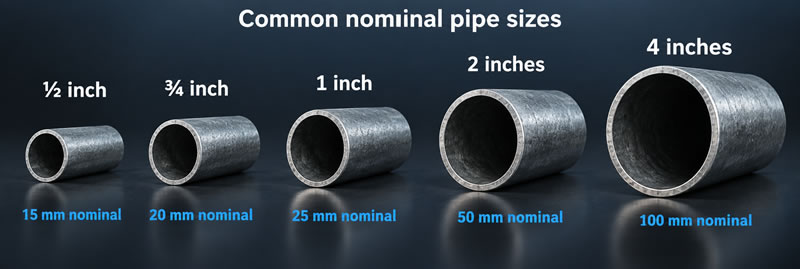
Always check the complete specification before buying a pipe or fitting. Material, schedule, pressure rating, thread standard and connection type can affect compatibility. Two products carrying similar inch and metric descriptions are not automatically interchangeable.
Inches to Millimeters FAQ
Measurement Standards and Further Reading
The inch is defined as exactly 25.4 millimeters. For authoritative information about length units, see the BIPM SI Brochure and NIST guidance on SI length units.