
This converter changes a length from millimeters to inches. The amount of length remains the same; only the unit and numerical scale change.
Millimeter to Inch Conversion Formula
One millimeter is equal to 0.0393700787402 inches:
1 mm = 0.0393700787402 in
To convert millimeters to inches, multiply by 0.0393700787402:
in = mm × 0.0393700787402
This factor follows from the meter definitions used by the converter: 1 mm = 0.001 m and 1 in = 0.0254 m.
Millimeter to Inch Conversion Table
| Millimeters (mm) | Inches (in) |
|---|---|
| 0.1 mm | 0.00393700787402 in |
| 0.5 mm | 0.0196850393701 in |
| 1 mm | 0.0393700787402 in |
| 2 mm | 0.0787401574803 in |
| 5 mm | 0.196850393701 in |
| 10 mm | 0.393700787402 in |
| 25 mm | 0.984251968504 in |
| 50 mm | 1.96850393701 in |
| 100 mm | 3.93700787402 in |
| 1,000 mm | 39.3700787402 in |
Why Convert Millimeters to Inches?
Millimeter-to-inch conversion is useful when measurements, specifications, maps, plans, scientific data or historical records use different length units.
For example, 2.5 mm = 0.0984251968504 in describes one physical length in two units. Converting the unit does not alter the measured object or distance.
Why Do Tyre Sizes Use Both Millimetres and Inches?
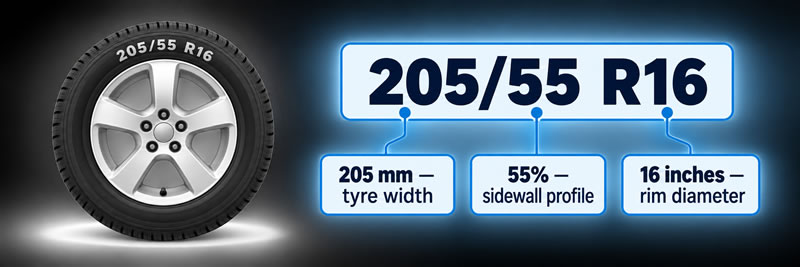
A modern tyre size such as 205/55 R16 combines metric and imperial measurements. The tyre width is stated in millimetres, but the wheel diameter is stated in inches. This mixed system developed as tyre technology became international while wheel manufacturing retained older inch-based standards.
How to read a tyre size
In the example 205/55 R16:
- 205 is the nominal width of the tyre in millimetres.
- 55 is the aspect ratio. The sidewall height is approximately 55% of the tyre's width, not 55 millimetres.
- R means the tyre has radial construction. It does not mean radius.
- 16 is the diameter of the wheel rim in inches.
Additional markings normally follow the size. For example, 91V contains a load index and a speed rating. These markings are important when selecting a replacement tyre, even though they are not part of its basic dimensions.
How the Mixed Tyre-Size System Developed
Early motor vehicles developed from carriage and bicycle technology. Wheels, rims and tyres were therefore commonly measured in inches in Britain and the United States. As the motor industry expanded, inch-based wheel diameters became established manufacturing standards.
During the twentieth century, European tyre makers increasingly used metric measurements to describe tyre width. Millimetres provided a convenient way to specify the smaller differences between tyre widths, while manufacturers continued producing tyres for existing inch-sized wheels.
After the Second World War radial tyres became widely adopted, their size descriptions commonly combined a metric section width with an inch-based rim diameter together. However vehicles, wheels, factories and service equipment were already designed around inch rim sizes, changing the entire system would have created unnecessary cost and compatibility problems.
Eventually the combined format became familiar around the world, now it is used in countries that otherwise rely almost entirely on the metric system. The result is a practical international convention rather than a measurement system designed from the beginning.
Why are wheel diameters still measured in inches?
Keeping established rim diameters makes compatible tyres and wheels easier to manufacture, identify, and replace because a tyre marked for a 16-inch wheel must fit the correct 16-inch rim, whereas relabelling that diameter as approximately 406.4 millimetres would introduce an unfamiliar number without changing the rim’s actual size, fit, or compatibility.
Tyre width is measured precisely in millimetres, while wheel diameter remains in inches because wheels have traditionally been made and sold in inch sizes.
Common Tyre Sizes Explained
| Tyre size | Width | Aspect ratio | Approximate sidewall height | Rim diameter |
|---|---|---|---|---|
| 175/65 R14 | 175 mm | 65% | 113.8 mm | 14 inches |
| 185/65 R15 | 185 mm | 65% | 120.3 mm | 15 inches |
| 195/65 R15 | 195 mm | 65% | 126.8 mm | 15 inches |
| 205/55 R16 | 205 mm | 55% | 112.8 mm | 16 inches |
| 215/55 R17 | 215 mm | 55% | 118.3 mm | 17 inches |
| 225/45 R17 | 225 mm | 45% | 101.3 mm | 17 inches |
| 225/40 R18 | 225 mm | 40% | 90 mm | 18 inches |
| 235/35 R19 | 235 mm | 35% | 82.3 mm | 19 inches |
The sidewall values in the table are calculated by multiplying the nominal width by the aspect ratio. For example:
205 mm × 55% = 112.75 mm
These figures explain the size markings but do not confirm that a tyre is suitable for a particular vehicle. Replacement tyres must also have the correct load index, speed rating, construction and manufacturer- approved fitment. Check the vehicle handbook, tyre-information label or guidance from a qualified tyre professional before changing sizes.
Millimeter and Inch Questions and Answers
Millimeters and inches frequently meet in manufacturing, electronics, automotive work, photography, printing, and imported product specifications. These problems use the exact relationship 1 in = 25.4 mm.
Standards and Further Reading
For authoritative unit guidance, consult the BIPM SI Brochure and NIST information about SI length.