Convert Celsius to Fahrenheit for weather reports, cooking temperatures, medical readings, and other everyday measurements.
How to Convert Celsius to Fahrenheit
Multiply the Celsius temperature by 9/5, or 1.8, and then add 32.
°F = (°C × 9 ÷ 5) + 32
Example: Convert 25 °C to Fahrenheit
First multiply 25 by 1.8, then add 32:
(25 × 1.8) + 32 = 77 °F
Therefore, 25 °C equals 77 °F.
Celsius to Fahrenheit Conversion Table
| Celsius (°C) | Fahrenheit (°F) |
|---|---|
| −40 °C | −40 °F |
| −20 °C | −4 °F |
| −10 °C | 14 °F |
| 0 °C | 32 °F |
| 10 °C | 50 °F |
| 20 °C | 68 °F |
| 25 °C | 77 °F |
| 30 °C | 86 °F |
| 37 °C | 98.6 °F |
| 40 °C | 104 °F |
| 100 °C | 212 °F |
The History of Celsius and Fahrenheit
The Fahrenheit and Celsius scales were developed during the eighteenth century, when scientists were working to make temperature measurements more consistent and repeatable.
How the Fahrenheit scale began
The Fahrenheit scale was introduced by German physicist Daniel Gabriel Fahrenheit in 1724. Fahrenheit was also known for producing reliable mercury thermometers. His scale used fixed reference temperatures so that different thermometers could produce comparable readings.
On the modern Fahrenheit scale, water freezes at 32 °F and boils at 212 °F under standard atmospheric pressure. This creates a difference of 180 Fahrenheit degrees between the two reference points. Fahrenheit remains the customary scale for everyday weather, cooking and household temperature measurement in the United States.
How the Celsius scale developed
Swedish astronomer Anders Celsius proposed a hundred-degree temperature scale in 1742. His original arrangement was reversed from the scale used today: water boiled at 0 degrees and froze at 100 degrees. The scale was reversed soon afterward so that higher numbers represented higher temperatures.
The scale was once commonly called the centigrade scale because it divided the interval between the freezing and boiling points of water into 100 degrees. The name Celsius was officially adopted internationally in 1948 to honour Anders Celsius and avoid confusion with another use of the term “centigrade.”
How the scales are used today
Celsius is now used for everyday temperatures in most countries and is closely connected to the metric system. It is also widely used in science alongside the kelvin scale. Fahrenheit is still widely used in the United States and several associated territories.
Although the scales use different zero points and degree sizes, they measure the same physical property. Water freezes at approximately 0 °C or 32 °F and boils at approximately 100 °C or 212 °F at standard atmospheric pressure.
How the UK Changed from Fahrenheit to Celsius
Celsius in British weather forecasts
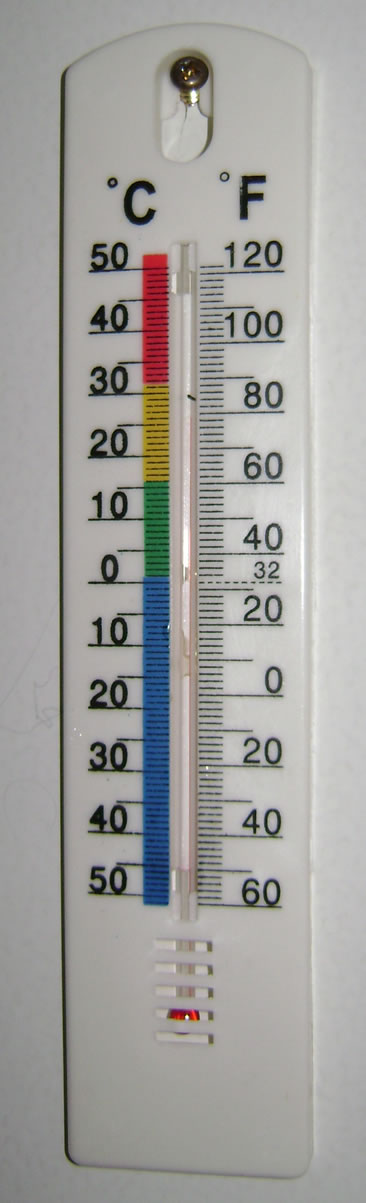
The Met Office began using Celsius as the primary temperature scale in public weather forecasts on 15 October 1962. For a transitional period, forecasts often included both Celsius and Fahrenheit so that viewers and listeners could become familiar with the new measurements. Celsius eventually became the standard scale in British weather reporting.
The change did not immediately remove Fahrenheit from everyday life. Many people who had grown up with the older scale continued to use it, particularly when talking about hot weather. Expressions such as “temperatures in the eighties” therefore remained familiar long after official forecasts had moved to Celsius.
Temperature measurement in the UK today
Celsius is now used throughout the UK for weather forecasts, education, medicine and most domestic temperature measurements. Food packaging and modern ovens also generally show cooking temperatures in Celsius, although older recipes may still give Fahrenheit temperatures or gas marks.
Fahrenheit has not completely disappeared. Older thermometers, cookbooks and historical weather records may use it, and some people still prefer Fahrenheit in conversation. Converting between the two scales remains useful when reading older British material, following American recipes or comparing UK and US weather reports.