Convert Fahrenheit to Celsius for weather reports, cooking temperatures, medical readings, and other everyday measurements.
How to Convert Fahrenheit to Celsius
Subtract 32 from the Fahrenheit temperature, then multiply the result by 5/9.
°C = (°F − 32) × 5 ÷ 9
Example: Convert 77 °F to Celsius
First subtract 32, then multiply by 5/9:
(77 − 32) × 5 ÷ 9 = 25 °C
Therefore, 77 °F equals 25 °C.
Fahrenheit to Celsius Conversion Table
| Fahrenheit (°F) | Celsius (°C) |
|---|---|
| −40 °F | −40 °C |
| 0 °F | −17.78 °C |
| 14 °F | −10 °C |
| 32 °F | 0 °C |
| 50 °F | 10 °C |
| 68 °F | 20 °C |
| 77 °F | 25 °C |
| 86 °F | 30 °C |
| 98.6 °F | 37 °C |
| 104 °F | 40 °C |
| 212 °F | 100 °C |
Why Does the Formula Subtract 32?
The two scales use different starting points. Water freezes at about 32 °F but 0 °C, so subtracting 32 aligns their zero points.
The interval between water’s freezing and boiling points contains 180 Fahrenheit degrees and 100 Celsius degrees. Multiplying by 5/9 adjusts for this difference in degree size.
When This Conversion Is Useful
Fahrenheit is used for everyday temperatures in the United States, while Celsius is used in most other countries. You may need this conversion when checking an international forecast, following a recipe, setting an oven, reading a thermometer, or interpreting scientific information.
Why Does the United States Still Use Fahrenheit?
The United States still uses Fahrenheit mainly because the scale was already firmly established before most countries changed to Celsius. American weather reports, household thermometers, ovens and heating and cooling systems were designed around Fahrenheit. Replacing this familiar system would require changes to equipment, public information, education and everyday habits.
The United States considered a wider move towards metric measurements during the twentieth century. The Metric Conversion Act of 1975 encouraged voluntary metrication, but it did not require businesses or the public to stop using customary units. As a result, Celsius became common in scientific, medical and international work, while Fahrenheit remained the usual scale for daily life.
Where is Fahrenheit used in the United States?
American television forecasts, weather websites and mobile apps normally display outdoor temperatures in degrees Fahrenheit. Domestic ovens use Fahrenheit settings, and thermostats commonly show indoor temperatures such as 68 °F or 72 °F. People also use Fahrenheit when discussing fevers, swimming-pool temperatures and unusually hot or cold weather.
Many Americans find Fahrenheit convenient for describing everyday weather. On this scale, 32 °F is the freezing point of water, temperatures in the 60s and 70s are generally associated with mild conditions, and readings above 90 °F indicate hot weather. Familiarity with these ranges makes a compulsory change less appealing to many users.
Is Celsius also used in the United States?
Yes. Celsius is regularly used in laboratories, scientific research, medicine, engineering and international communication. Students learn both scales, and many digital devices allow users to switch between them. Product labels and technical documents may also provide both Celsius and Fahrenheit values.
Because the United States uses Fahrenheit for everyday purposes while most of the world uses Celsius, conversion is often necessary when checking overseas weather, following an international recipe, reading scientific material or preparing for travel.
When Are Celsius and Fahrenheit Equal?
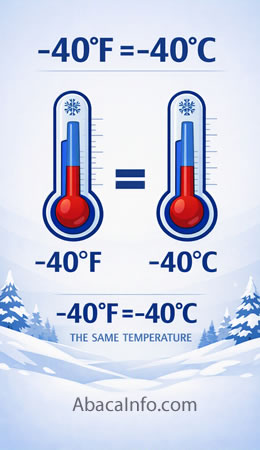
Celsius and Fahrenheit have the same numerical value at −40 degrees:
−40 °C = −40 °F
This is the only temperature at which the two scales display the same number. It happens because Celsius and Fahrenheit use different zero points and differently sized degrees. A temperature change of 1 °C is equal to a change of 1.8 °F, while 0 °C begins at 32 °F on the Fahrenheit scale.
Why do the two scales meet at −40?
Start with the Celsius-to-Fahrenheit formula and use the same unknown value for both scales:
°F = (°C × 1.8) + 32
If both readings are equal, the equation becomes:
C = (C × 1.8) + 32
Solving the equation gives:
C = −40
You can confirm the result by placing −40 into the conversion formula:
(−40 × 1.8) + 32 = −40 °F
Why is this temperature interesting?