Use this minutes-to-seconds converter to express a time measurement in seconds. The conversion is based on the exact relationship between minutes and seconds.
Minutes to Seconds Conversion Formula
Every minute contains exactly 60 seconds:
1 min = 60 s
To convert minutes to seconds, multiply the number of minutes by 60:
Seconds = Minutes × 60
For example, to convert 4 minutes to seconds, calculate 4 × 60 = 240 seconds.
The History of Minutes and Seconds
Minutes and seconds have ancient origins. Long before mechanical clocks existed, people measured time by observing the movement of the Sun, Moon and stars. Early civilizations divided days into smaller periods to organize work, religious observances, travel and astronomical study.
The use of 60 as the basis for minutes and seconds is commonly associated with the ancient Babylonians. Their mathematics used a base-60 system, also called the sexagesimal system. Sixty was practical because it can be divided evenly by many numbers, including 2, 3, 4, 5, 6, 10, 12, 15, 20 and 30. This made it convenient for calculations involving fractions.
How the minute developed
Greek astronomers adopted base-60 calculations when studying angles and celestial movement. They divided a degree into 60 smaller parts. Medieval scholars later described the first small division as the pars minuta prima, meaning the “first small part.” The word minute developed from this expression.
The same system was applied to time. An hour was divided into 60 minutes. Early clocks did not always display minutes because their mechanisms were not accurate enough to make such a precise reading useful. Minute hands became more common as clockmaking improved during the late Middle Ages and early modern period.
How the second developed
Each minute was divided again into 60 smaller parts. This second division was called the pars minuta secunda, or “second small part,” which gave the second its name. Therefore, one minute contains 60 seconds, and one hour contains 3,600 seconds.
Second hands became practical after advances in mechanical clocks made more precise timekeeping possible. Pendulum clocks introduced during the 17th century greatly improved accuracy, allowing seconds to be measured reliably in homes, laboratories and observatories.
Minutes and seconds today
Historically, the second was defined as a fraction of the average solar day. However, Earth’s rotation is not perfectly uniform, so modern science required a more stable definition. Today, the second is defined using a precise atomic transition in the cesium-133 atom. Atomic clocks use this standard to maintain extremely accurate time.
Minutes and seconds remain part of everyday life. They are used for clocks, transport schedules, cooking, exercise, sports, videos, music, examinations and scientific measurement. Although the second is an International System of Units base unit, the minute is accepted for use with it. Their familiar base-60 relationship preserves a timekeeping tradition that began thousands of years ago.
Minutes to Seconds Conversion Table
| Minutes (min) | Seconds (s) |
|---|---|
| 0.1 min | 6 s |
| 0.25 min | 15 s |
| 0.5 min | 30 s |
| 0.75 min | 45 s |
| 1 min | 60 s |
| 1.5 min | 90 s |
| 2 min | 120 s |
| 3 min | 180 s |
| 5 min | 300 s |
| 10 min | 600 s |
| 15 min | 900 s |
| 20 min | 1,200 s |
| 30 min | 1,800 s |
| 45 min | 2,700 s |
| 60 min | 3,600 s |
| 90 min | 5,400 s |
| 120 min | 7,200 s |
From more than a minute to less than 60 seconds
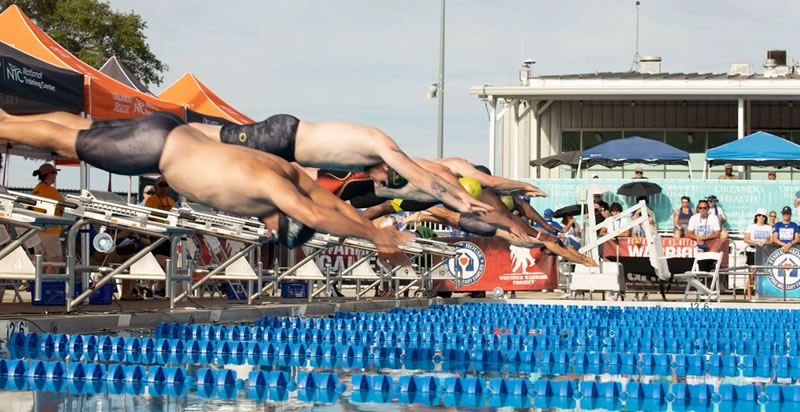
The men’s 100-metre freestyle swimming race shows how athletic performance has improved over time. At the 1896 Olympic Games, Alfréd Hajós won the event in 1 minute 22.2 seconds. Converted entirely into seconds, that time is:
1 minute 22.2 seconds = 82.2 seconds
At the 2024 Paris Olympics, Pan Zhanle swam the same distance in 46.40 seconds. His performance was comfortably below one minute:
46.40 seconds ÷ 60 = approximately 0.773 minutes
The difference between the two winning times is 35.8 seconds. Better training, technique, swimming pools, starting blocks and sports science have all contributed to faster performances.